- Conservation Rising
- Posts
- Q&A: The anatomy of a fair carbon deal
Q&A: The anatomy of a fair carbon deal
From the newsletter
What does a fair deal look like for communities in nature-based carbon projects? For 15 years, Carbon Tanzania has been attempting to answer that question by putting revenue directly into the hands of the people who protect their forests. In this dialogue, two of Carbon Tanzania’s Project Managers discuss the nuances of this revenue-sharing model.
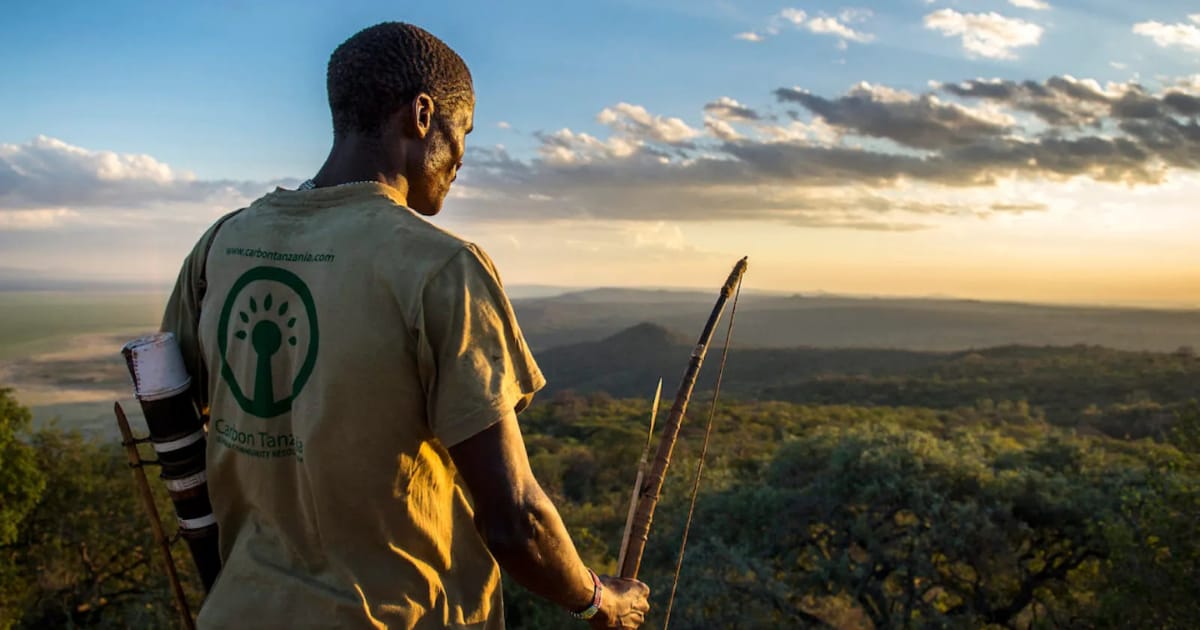
Isack Bryson shares insights from his community in the Yaeda-Eyasi Landscape where hunter-gatherer and pastoralist communities jointly protect the forest, while Hosea Elia Kiyogoma discusses the community-led nature of forest protection in the Ntakata Mountains.
They reveal how their model of giving 61% of revenue to local communities has worked and how this unified approach to revenue sharing adapts to the uniqueness of the people in very different landscapes.
More details
Q: How is carbon revenue shared between the project developer and the local communities in your project area?
Isack: First of all, us as a community, the owner of the resources, we get the higher percentage from this distribution – 61%. Carbon Tanzania, as our closest partner, gets 31% and the Designated National Authority gets 8%. From our 61%, the district government gets 8% because they support us in the case of challenges which are beyond our ability to solve, we give the regional government 1% and we give the President's Office, Regional Administration and Local Government 1%.
Hosea: As revenue sharing is regulated by government policy, 31% of our credit sales go to Carbon Tanzania, 8% goes to the Designated National Authority (the Vice President’s Office) and 61% is allocated to the forest-owning community. The community’s 61% share is further distributed; 51% to the community, 8% to the District government, 1% to the Regional Administration Office, and 1% to the President's Office, Regional Administration and Local Government.
Q: Beyond the initial transaction, how does the revenue sharing model shift the power dynamic from "aid recipient" to "active economic partner"?
Hosea: This approach fundamentally changes the relationship, moving communities from being passive recipients to producers of a global commodity, specifically the carbon credit. This shift provides communities with negotiation power, enabling them to sign agreements rather than just receiving aid, as demonstrated by the agreement Carbon Tanzania signed with eight villages in the Ntakata Mountains forest project. This arrangement gives the communities a share of ownership over the business, reinforcing their ownership of their forest, and the conservation initiatives. This in turn provides revenue for developing the forest conservation and economic activities as well as for essential infrastructure such as schools and healthcare.
Isack: This is our land. The credits are generated by our forests that are protected by our community scouts, so the credits belong to us. We are the primary owners of the forest and therefore the credits and resulting revenue. Those partnering with us receive a percentage for their efforts, just as in any business partnership.
Q: Fair revenue sharing is often easier said than done. How do your respective projects ensure that the most marginalised members of the village have a direct say in how the carbon finance is spent, rather than just the village leadership?
Isack: In general our project applies an inclusive and participatory approach. We use meetings to engage with the entire community. We have small meetings from the level of individual community members and larger Village General Assemblies. But beyond that we go to the most marginalised individuals to see how they can participate in different decisions regarding our project. Additionally, the project staff are from within the project area so we meet the youth on the street, we attend church and we listen to our neighbours when they face a challenge so we can really learn what is important to them.
Hosea: To ensure that marginalised members, and not just the village leadership, have a direct say in how carbon finance is spent, inclusive and participatory decision-making is enforced through governance tools. This includes full participation in Village General Assembly meetings by all community members, including youth, vulnerable people, elders, and women, who have an equal opportunity to provide opinions on progress reports and revenue expenditure. Furthermore, transparency is maintained through financial systems where revenues and expenditures are published and displayed at village offices, supported by an independent audit and community monitoring committees.
Q: What tools do you use to evaluate the social impact of carbon revenue flowing into the community?
Hosea: Through the REFLECT social impact evaluation, several tools are being used to evaluate the social impact of the carbon finance flowing into the community, including household surveys focusing on income and well-being. Other tools include an evaluation of community well-being, and gender inclusion indicators. This information is then used as a key informant to the calculation of the social return on investment of the project.
Isack: We have this custom of calling meetings and people are asked for their opinions. Individuals will tell us that this is good or there is a challenge here, we have to adjust here and so on. We have gone a level deeper to obtain an individual’s viewpoint by moving from individual household to another, including youth and women, and from one leader to another. We share this in implementation reports with Carbon Tanzania. We sometimes receive researchers within the country and outside the country. Individual researchers coming to learn what is the fate of the project, what is the result of this project.
Q: When we talk about 'benefits,' the global market usually looks at dollars per ton. In your specific landscapes, what is one 'non-monetary' success that you believe is more valuable to the project’s long-term survival than the finance itself?
Isack: The primary benefit is the support of the foundation of their nature-dependent life. Through protection activities we see improved forest density, biodiversity, and animal populations, which sustains our traditional lifestyles of hunting and gathering, as well as pastoralist grazing. The securing of our land secures the culture and traditions of our communities who have lived in the landscape for tens of thousands of years. This is priceless.
Hosea: Significant non-monetary benefits have been realised, including a restored sense of land ownership and stewardship, which has led communities to enforce bylaws themselves and has decreased illegal deforestation. Other examples include the revival of traditional conservation practices, reduced conflicts over land and resources achieved through the development of village land use plans, and increased trust in village governance. Additionally, women are gaining confidence in public decision-making.
Q: If you could tell a carbon credit buyer in London or New York one thing about the people who actually 'produce' these credits, what would it be to help them understand that they aren't just buying a 'climate solution,' but are supporting a fair and just social contract?
Hosea: Buyers are not just purchasing a carbon credit to compensate for their emissions but are entering into a partnership with communities who choose to protect forests instead of exploiting them, often there is a real economic sacrifice in the early stages. While mitigating their own contribution to climate change, the buyer also facilitates development; encouraging good agricultural practices through sustainable village land use planning, supporting women and youth in leadership roles, and funding community development projects like beekeeping, fish farming, education and healthcare.
Isack: To our dearest buyers, our traditional lifestyles are hugely dependent on nature for food, for medicine and for grazing pasture. To secure nature is not optional for us. It is compulsory. We have this challenge of competition for land, for natural resources and now, as a result of the industrial revolution which is emitting a lot of emissions, you also have the challenge of climate change that needs the protection of nature. We have seen that if we fail to protect nature, it will harm our life and the life of the global community through extreme weather events. Nature protection happens on the front line and we really are on the front line. This carbon project is the best approach as it is compatible with our culture. Trees are standing while we are earning money addressing our situation of poverty. So I request you buyers to support this approach by purchasing our credits through an authentic mechanism that can rescue our shared world.